
Types of fluorescent lamps with g13 base and technical specifications
Use fluorescent lamps (TLL) are still in use today, but gradually they will be replaced with other, more efficient and convenient sources of light. In the tazi article, we are talking about fluorescent lamps with a g13 base, we will analyze how it is and how it is connected.
containment: 1. G13 base/plinth design and dimensions 2. Characteristics on lamp T8 and T12
G13 base/plinth design and dimensions
Structurally based on a T8 (T12) fluorescent lamp, it consists of two messing and shields, pressed into the lid, made of insulating material. Darzhacht from his own country e in metal glass. The edge on the TLL is stuck in glass. The length on the pinion is 7 mm, the distance between the centering is 13 mm. Outflow and marking on the basis - g13.
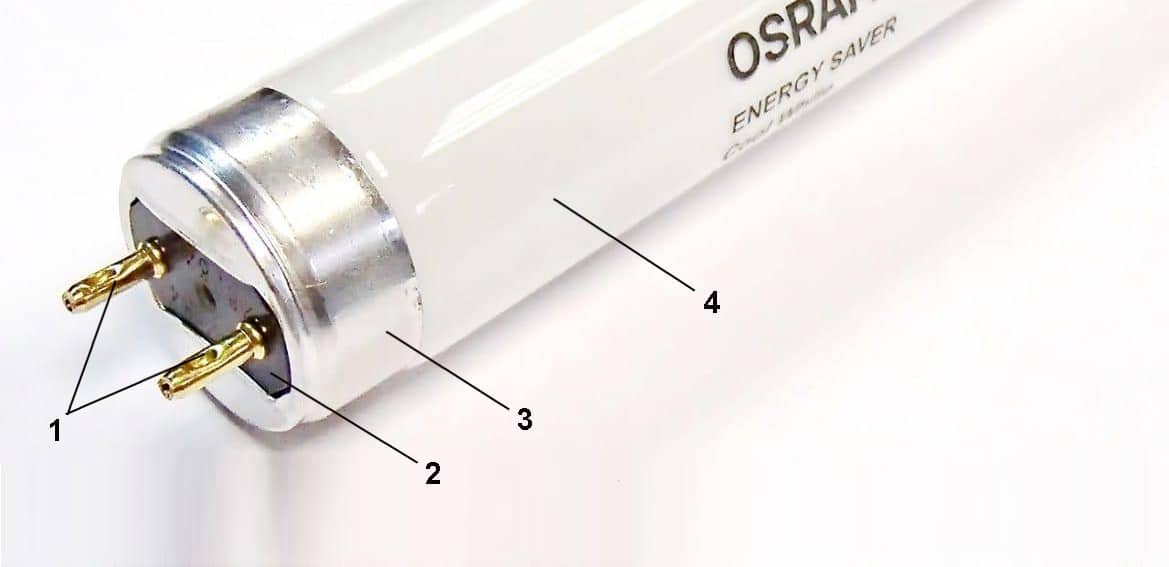 Improved look and design based on G13
In the picture, the numbers show:
- Shchiftov tins.
- Darzhach.
- bowl.
- Crush lamp.
Crush with such a base to connect the electrical grid with the help of special rotating contacts.
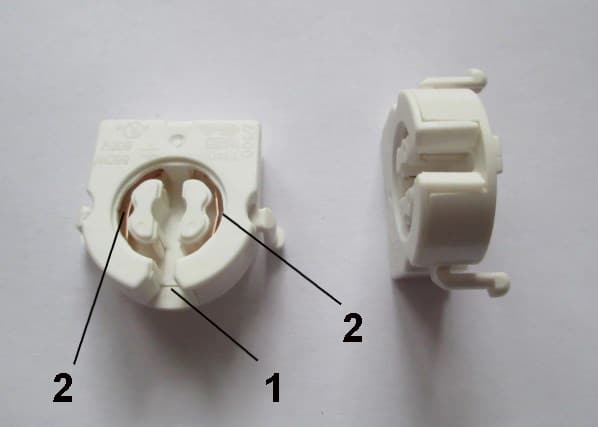 Rotating chamber G13
For yes, they will turn, shift on the basis of the first sevkarvat in the zhleb 1, the trace of some cyalata needs to be turned 90 degrees, and current the conductors on the lighting device dokosvat contact on the cassette 2.
Hello. Ima and chambers for G13 bushings. In tosi, the case of a shift is based on simply se vkarvat in the open on the chamber.
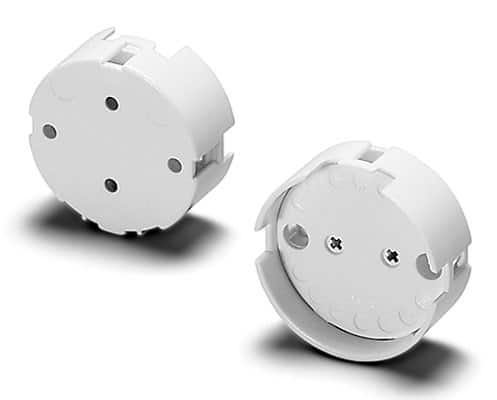 Yaka chambered G13 back kjm sdzharzhanieto ↑
Characteristics on lamp T8 and T12
The main characteristic on T8 (T12) TLL is not a very typical form. Such a device can be installed by itself in a special lamp.This is a protection device from Tosi type, this rule is used for lighting in the public, educational, medical, industrial premises, offices, warehouses.
Longer on the hill variat significantly (look at the table in a mountain), for some reason, light the wind and sa with a suitable standard size. This type of fluorescent lamp is a glow discharge device, pulling two electrodes, located at different edges on the tube. Tova means that the device has two g13 sockets.
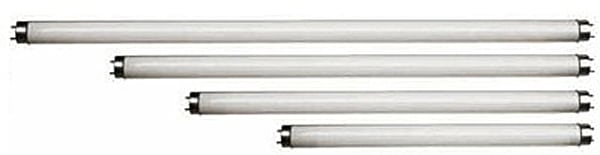 Require light lengths with different lengths, in spite of the equipment with a single and removable G13 base
Tova device izlchva svetlina on tsyalat surface and vvvsichki shoki, with an exception to the edges. Illuminate the bodies from such a source to the light wind and imat special reflectors, so don’t ruin the stream often from the light, illuminating the light on the self-illuminating body.
The next characteristic comes from the principle of working on TLL. In order to prevent the turning of a luminous discharge into a device, it is possible that a luminous source may be included in the source itself through special control equipment, EMPRA or an electronic ballast. The osiguryava device was removed and started up on the illuminator.
Important! The power to the ballast is a ripple and the response to the power to the electric breaker. The rule “tacky longer, sensible in a good way” don’t work here.
Depending on the type, TLL with base g13 can be designed for voltage 220 or 110 V, but it can be expected when choosing a lighting rod and controlling device for it.
Like in all other fluorescent sources on light, the devices from tosi type are kept alive and, therefore, specially made from Khvarlians - you can’t just eat such a krushka in a kofata for a bokluk.
Kakvo sa
T8 and T12 fluorescent tubes with G13 base are offered in various sizes and powers. Kolkoto is a long device, more sensible energy of the consumer and, in response, sensible in a temple, it generates a bright stream. Size and base specifications on a T8 and T12 g13 lamp, based on the IEC standard, as shown in the table below.
Fluorescent lamps T8 with warp G13
Length, mmPower, WatCreated a bright stream, lm43715600589166405891872043820800589208009702392089430120011993212801149331320104734136011993614401047381520150050200015005823201763702800
Fluorescent lamps T12 with warp G13*
Length, mmPower, WatCreated a bright stream, lm6042080012134012001514652600151480320017781004000
* Lampe s with standard size T12 are considered obsolete and practically do not produce today.
Schemes on the wire
Somehow, unfortunatelly, TLL can’t and can’t send it directly to the media - they all need special ballast. There are two types of devices - electromagnetic (EMPRA) and electronic electronic ballast.
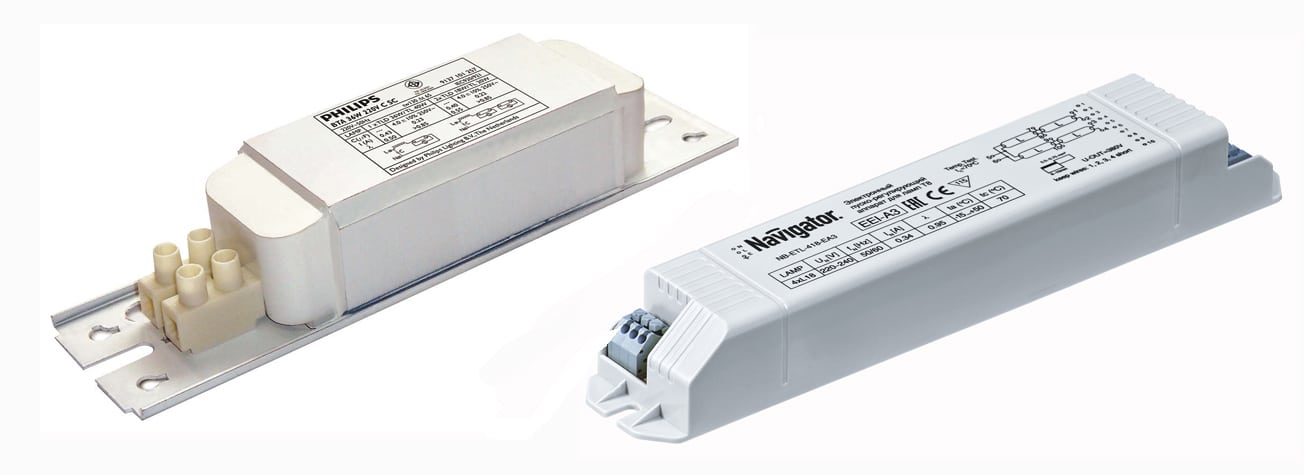 Electromagnet (loudly) and electronic ballast
If you turn on the fluorescent lamp through an electromagnetic device, then in addition, you also need a starter, which is already installed on the device.
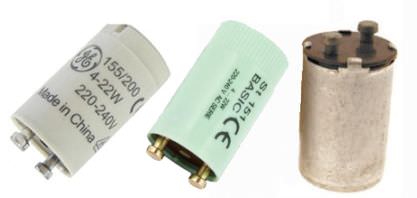 Starter for starter on fluorescent lamp
When using the electronic ballast, the starter is not needed - the device for the student start is directly inserted into it.
And now we are looking at typical schemes for linking to TLL from various types using electronic ballast and electronic ballast. Ako imame EMPRA (throttle) and a lamp for a voltage of 220 V and power for the lighting device and EMPRA are connected, togawa verigat more like this:
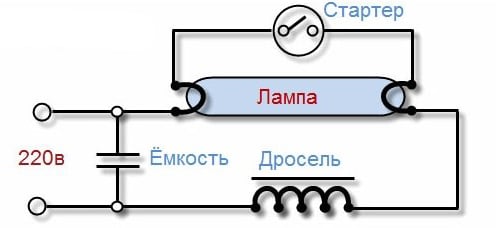 Schematic connected to TLL via EMPRA and starter
Dokato lampata is excluded, but it is not contrary to the requirement, but the heating of the bimetalate is in the starter.When heated, the starter shutters are flat, then the prez spiralite increases on the crankcase and they heat up. According to the time, it is cooling down, boiling the verigata, full intermittent voltage supplying the electrode, and droselt, for the sake of reverse induction, issuing an impulse with a high voltage to the electrode, which fuses the lamp. Vednaga trace of the cato lamp is brighter, the throttle is switched to the current-limited mode, preventing flashes from appearing on the arc discharge. The capacitance (capacitor) is necessary to compensate for the reactive component on the electronic ballast, which, in turn, begins to increase efficiency on the lighting body.
Ako lampite sa 18 W and 110 V, then the schematic diagram on the link is somehow as follows:
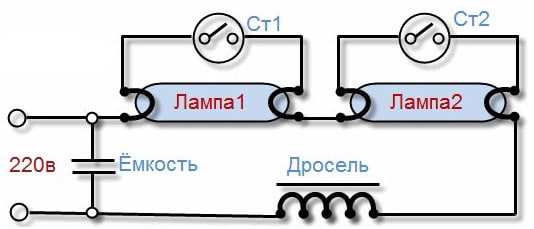 The circuit is connected to a lamp with an operating voltage of 110 V
When sglobyavaneto on the pelvis, the scheme is trebva and all spazvat, follow the conditions:
- The power and type on the lamp is trebva and sa ednakvi.
- The power for the electronic ballast is equal to the total power for the lamp.
- Starter is shaking and has a working voltage of 110 V.
Sega electronic ballast. Somehow, we need a starter and a standard chain for an illuminating rod with a similar device, which looks like this:
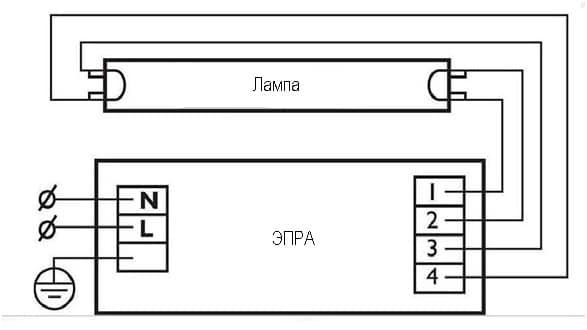 Standard circuit connected to TLL via electronic ballast
It is connected to a switchgear, which controls the device independently igniting the lamp with an impulse with a high voltage and, in time, for operation and maintaining the current, reducing the device to the necessary power.
What does this scheme refer to as a practical scheme, togava in every way depends on the samiya ballast. Ima devices for storing one, two, four and dory pole lamps with different capacities. Therefore, it is connected to the TLL by the device and all the perversions in accordance with the diagram attached to the diagram.Among other things, the tasi scheme is almost vinagi, attaching a hull to the device.
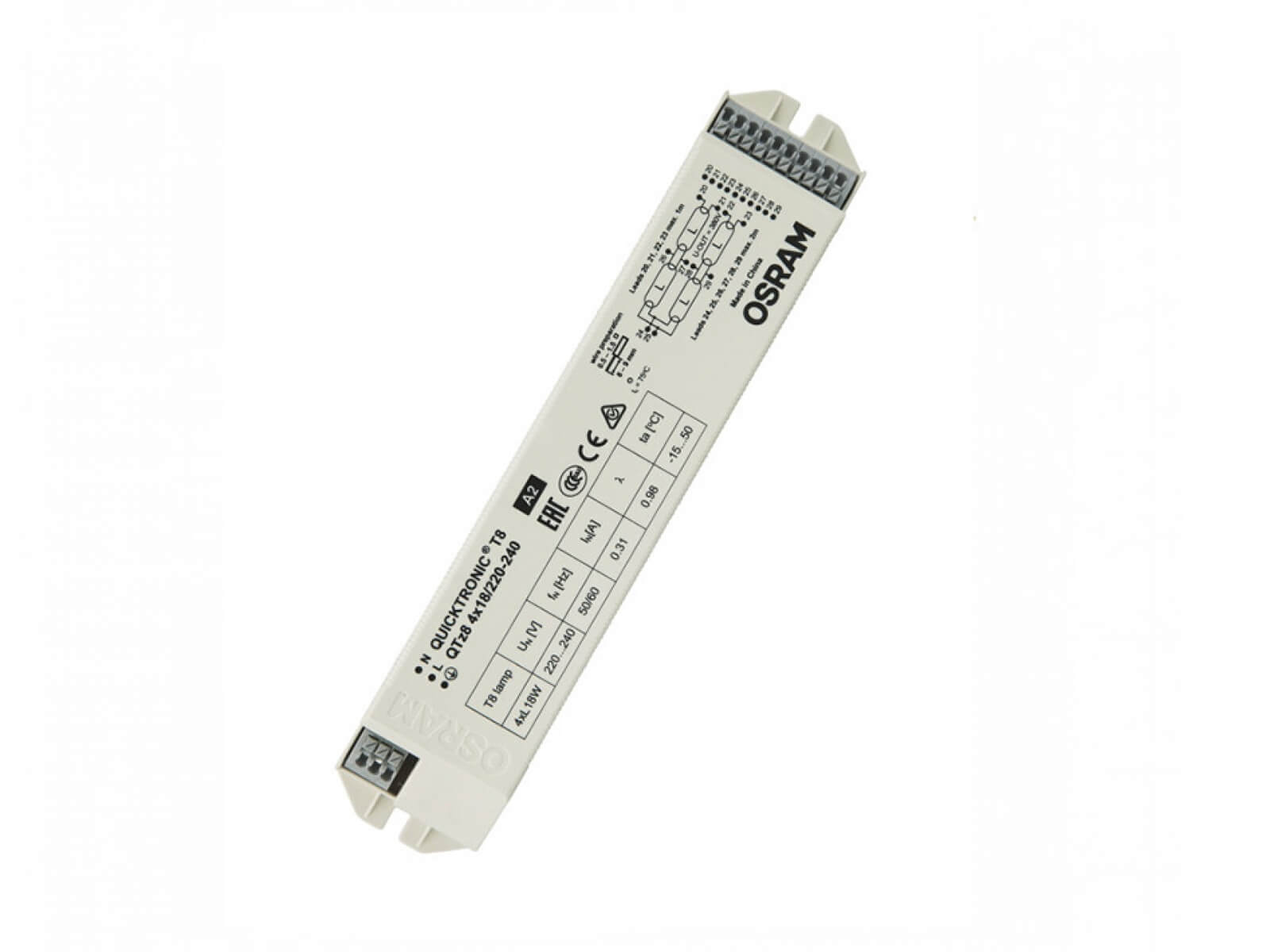 Tozi electronic ballast, somehow sevide from the diagram on the low voltage, you can store 4 lamps of 18 W each
In this way, you need to understand the fluorescent lamps and the circuit for quickly turning on and in a short time you will learn how to use which lamps the G13 is based on and how to design them.
PredishnaFluorescentSpecifications and related to 36 W fluorescent lampsNextLuminescentThe main technical characteristics and diagram on the link to the lamp LB 40 - how do you change it