
What is the starter for a fluorescent lamp?
Contrary to recent developments in semiconductor technology, fluorescent lamps (FL) are widely used. It is single from the main components, oscillating work on a light source from a tosy type, not a starter. In the basin of the article, we will analyze how the starter is for the lamp, how it is and how it works.
containment: 1. How is the starter 2. Kakvi sa starter for lamps 3. Decoded for marking 4. How to choose a starter - practically try on
How is the starter
What is the device? What is the starter for? For yes, we will analyze these problems, we will analyze how a fluorescent lamp is represented, how it works and how it differs from other types of light sources.
Diagram for switching on a fluorescent lamp
Let's look briefly at the principle of working on a fluorescent lamp. Structurally, LL is a glass flask for the size of a tube, two electrodes are sealed at the edges. The need for e pylna sas mixture from inert gas, mixtures from betting gum. From the outside, a layer of phosphorus will cover with a layer - a substance that is capable of emitting visible light when exposed to ultraviolet light.
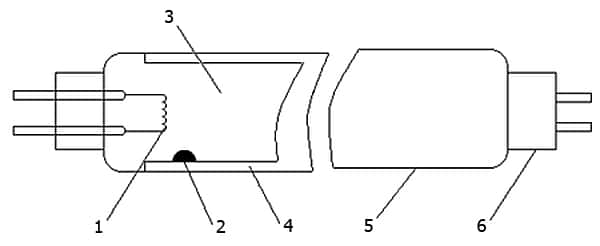 Design on fluorescent lamp
Show on the figurine:
- 1 - electrode;
- 2 - metalen zhivak;
- 3 - inert gas;
- 4 - phosphorus;
- 5 - glass flask;
- 6 - double pin base.
Whenever an electric kettle, put an electrode on it, a light discharge is shining on the ground, some kind of punishment is atomized on the livestock and the ultraviolet light is emitted. The last actions of the top of phosphorus, which punish and shine brightly.
It’s not easy to see everything, but it’s more difficult in practice. In a studen lamp almost whole zhivakse condenser under the captcha format, koito sa se hid the top of the krushkat. In this case, the resistance to the gaseous medium between the electrodes is sensible, but if you get rarefied, if you apply voltage to the lamp. For the application, please follow the conditions:
- The electrodes are pre-heated in advance, in order to increase their ability and remove the electronics.
- When the electrode is applied, the voltage is increased, enough for destruction to the gas distance.
These tasks are performed from a starter with an electromagnetic throttle. They are indispensable elements for any fluorescent lighting body. Some da look at the classics Diagram on a fluorescent lamp ss starter and throttle.
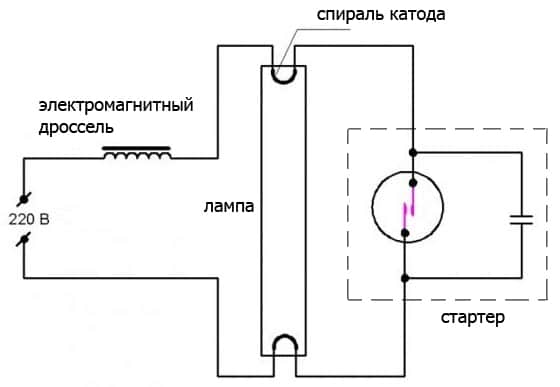 Lighting chain with LL
When the lamp is not on, contact the shutter starter. The soil is heated on a spiralite on an electrode, which is connected in series with the throttle of the mrezhat. Vednaga trace the cato, wind it up and warm it up, start the broth of the verigata. On the electrode on the lamp, for the sake of self-induction in the throttle, se appearing an impulse with a high voltage (800 - 1000 V), some fuse of the lamp.
In the need for a soil discharge, which turns a livestock into a state of steam. Tova namalava resistance to the gasy distance. Now LL work at low voltage - working voltage.
Device and principle for action
From the influence of the starter on the top of the fluorescent lamp, let's analyze the principle of this work.How does the device know how long it takes to warm up the spiral? How is it determined that the lampata did not shine and did not need it from her? Some da razgledam design on the starter.
All in all, a gas-discharge cap is small in size. To him, a definite voltage is applied - a smoldering discharge in the flask is behind the back, the lamp is luminous. But tazi krushka ima is one constructive feature. The single electrode is directed under the format on the movable bimetal plate.
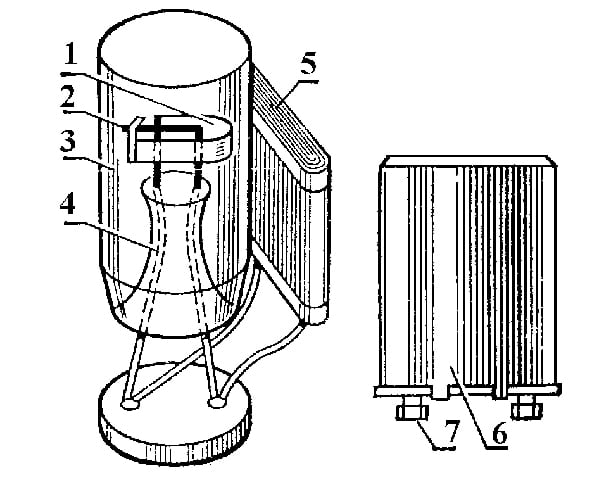
Starter for fluorescent lamp
On the diagram, digits show:
- 1 - bimetallic electrode;
- 2 - the electrode is motionless;
- 3 - glass flask, pylna with neon;
- 4 - conductors on the electrode;
- 5 - capacitor;
- 6 - protected body (thick);
- 7 - base.
For yes, let's analyze the principle of working for a starter, we’ll make some sketches for linking to LL, given in a mountain. And so, including the lampata of the mrezhata. On the electrode on the lamp and the starter, there is an inter-voltage.
Behind neon light the voltage on the starter is not enough for the starter. In the krushka mu, a discharge was shining, some soil and heating the electrode. Made from bimetal, that se ogva and zatvarya from the second, motionless. The lamp on the starter is out of gas and the current is not closed, the ground and the flow are prez the spiralate LL, the heater is on the cathode.
The trace is well known to the time of bimetalnate during the period of cooling naturally and of course. The contact between the electrode on the starter e preksnat, tokt vvv verigata spiral. Throttle, for the sake of self-induction, producing a pulse with a high voltage, which is when applying a cathode to a fluorescent lamp. High-voltage pulse ignited a discharge into the LL bulb.The operating voltage is set on the non-hot cathode - 130-140 V.
This voltage is not sufficient, the task is to pre-discharge the discharge into the lamp at the starter, and therefore the voltage on the ignition is 180-200 V (for 220 V starter). So, like LL e started, the starter did not participate in the natatishnat mu work. Ako started unsuccessfully, the starter repeats the process on the trap.
For what is the capacitor in the chain?
On the figure in the mountain number 5, there is a capacitor. Don't speak for him. How is the capacitor represented and for what? Tosi element, present in all of the gas-discharge starter, acting as a spark arrestor. Commonly manufactured charter or high voltage ceramic device with capacitance up to 0.05 μF.
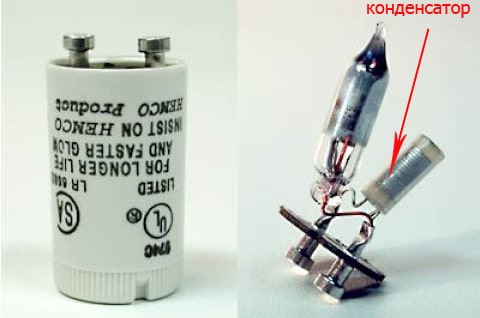 Capacitor for squeeze on sparks in starter
At the moment on the boil on the electrode on the neon lamp, a pulse appeared with a high voltage at the top of the tyah, as well as at the top of the cathode LL. This is the voltage of the predizvikva of the electric arc, which is the “plazga” ass, open all the contacts. As a result, they will burn out on tov contact, and they can dori and they will close up, they will “brew” one friend. The result is a bright paint on the starter for a while for maintenance and as a result of contact with it, damage. The condenser for receiving the first blow at the moment on the decoction on the electrode - that smoothness is often intended for high-voltage impulses, which, after giving time for contact, will open it.
Ima friend important function on the capacitor for squeezing on the spark. At the moment when the electrode is boiled to the starting device, there is a natural spark gap on Popov, emitting electromagnetic waves in almost all ranges.As a result, at the same time on the starter on the fluorescent lamp, the sound is farting in the high-speaker on the radio receiver and the sound amplification equipment, and on the screen on the TVs and monitors, you observe the waves. The condenser is torn away from all these problems.
Do not remove the capacitor, installed in the starter, from the capacitor, connected in parallel with the lighting rod. Those perform different tasks.
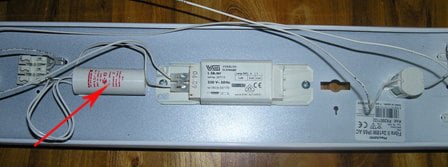 Tosi capacitor paint the reactive component on the lighting body.
How yes check gave work
Lesno, yes, check your starter for a fluorescent lamp. That tryabva and be svarzan kam mrezhata through an ordinary lamp with a pressurized liquid with a power of 20-60 watts.
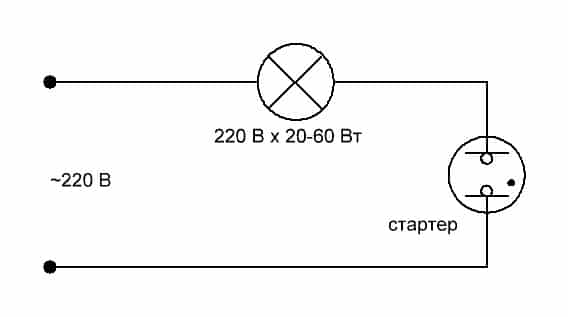 Scheme for checking for a starting device for LL
Ako lampata with a lit chick of a moment periodically, then the starter is working correctly. Otherwise, the starting device could still be replaced.
The power to the lamp with the ignited switch is also selected from the girth to the power to the fluorescent lamp, for which the starter was designed and operated.
Kakvi sa starter for lamps
How does the starter work, razbrahme. Leave it alone and let us analyze how it is and how it differs one from the other. In the first place, tryabva yes, you know what the starting device is, what work they have done, and I have a different type of starter - electronic. Those perform tasks, but at the top are electronic components - diodes, thyristors, transistors, capacitors, etc.
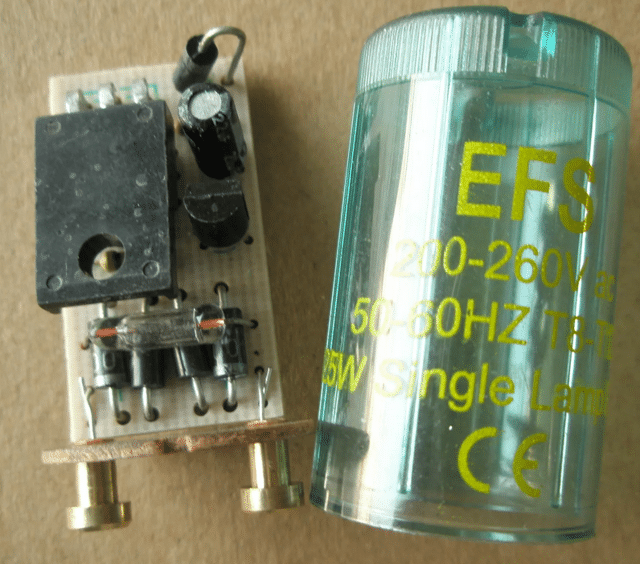 Electronic starter
What is the difference between such a solution and a classic discharge lamp? Tova sa basic representation on the electronic scheme:
- An exploitative belly. The electronic starting device is no mechanical contacts, which burn, and the bimetal plates, which have the property of being “scream”.
- No slander. The non-contact design has a minimum of electromagnetic disturbance, which means it has little to no effect on sensitive equipment.
- Increasing the resource by LL… The electronic starting device is loaded with a coil with an optimal current and a strictly defined time. As a result, on the head of the “starter” lampat in a forest, spiral on the wire, the electrodes do not destroy it from overheating or a cold start.
- Turn off the start lamp... Ako LL did not exhaust the resources of the si and the starter is difficult (for example, the option of the starter and the trace of the output), then the starter is excluded from the mrezhat.
- Pre-production protection... Ako tokt prez spiral nadvishi admissible stoynost, starter excluding the lamp. Tova izbyagva pregryavane on drosela and fire in case of a malfunction on the lighting rod.
- Wide operating temperature range... The electronic version can work under the same temperature conditions - from -30 to +85 ° C. This allows you to use it in street lamps and objects with the same temperature conditions.
The price is a lot higher (up to 10-20 five) for a gas discharge starter. Such a thing is not a fault, and it’s a good idea to replace the gas-discharge device for a starter with an electronic one.
Now for the difference between the beginnings, regardless of the technical design. Trigger for fluorescent lamps differ in two main characteristics.
Through operating voltage... Somehow, the tension is on the starter on the starter, the trembling and the low from being stored on the lamp, but on the high from the work the voltage is on the lamp. Opposite is the case of lampata yama and starter (intermediate voltage is low) or starter nyama and all, turn off the trace of the starter on LL (working voltage on lampata is high).
They will offer all starters for two working voltages - 220 and 110 V (usually they are in the range of 110-130 and 220-240 V). First, use it with a 220 V lamp, repeat with a 110 V lamp. Lamps from 110 V can and work at 110 or 220 V. In the second case, they turn on by two, for which every lamp uses its starter from 110 V.
Hello! Spored GOST GOST 8799-90 (preprint 2004), the starter is produced for voltage 127, not 110 V.
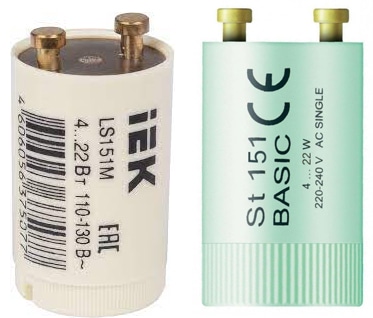 Trigger for 110 (loudly) and 220 V lamps
By silata... All this is related to power on LL, with some device it is better to work. If the power on the lamp came out of the girth, it is connected to the starting device, then the starter is still unreliable on the LL, or generally it does not happen. Osventova, a very powerful lamp, now burn out, contact the starter itself. Usually, the girth on the power on the lamp is attached to the body on the starter. For example, the device, the indications on the picture in the mountain, can and work with power LL from 4 to 22 W.
Ima and a little more important are the differences - the material on the cases, protection from moisture, UV resistance on the cases (it is important to catch the lamps), the manufacturer, etc.
Decoded for marking
Nyama is the only rule for marking on the starter for fluorescent lamps. Ima have a lot of options for the designation. According to GOST 8799-90 (preprint 2004) „International standard.Starters for fluorescent lamps "homemade starters for marking, as follows: [XX] [S] - [YYYY] - [Z], kadeto:
- [XX] No lamp power, for which the starter is intended, and:
- 20, 80 - limit on the power on the lamp, for which the starter is intended, the upper limit is on the power of 4 W;
- 65, 70, 85, 90, 125 - power ratings per lamp, for which the starter is intended.
- C - starter.
- [YYY] - nominal voltage on the starter (127 or 220 V).
- [Z] — difference from base model (1 or 2).
For example, the picture below shows the starter, intended for lamps with a power of 4-80 W and for a working voltage of 220 V.
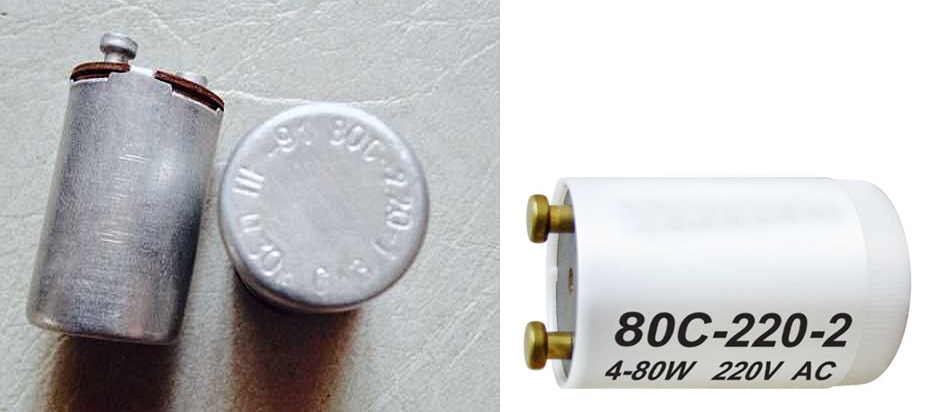 Starters 80S-220-1 (forward) and 80S-220-2 GOST 8799-90
Now for the strange etiketyran. OSRAM usually starts with the letter ST and a three-digit alphabetic code.
Label table for the most popular launchers and devices for LL OSRAM
TypeVoltage, V Lamp power, W OsventovaST 111220-2404-80ST 171220-24038-80degree prefacing *ST 173220-24015-32degree prefacing *ST 191220-240100-140ST 151110-1304-22ST 172110-13018-22degree prefacing pasitel *
* for electronic model.
Philips clear your mind with the S symbol and the numeric code. For example, the modification S2 e is designed to work with a lamp with a power of 4-22 W at a voltage of 110 or 220 V. S10 e is designed for a lamp with a power of 4-65 W at a voltage of 220 V. Ima sa and the power device from Tazi company. For example starter S12 can work with 115-140 W lamps at 220 V.
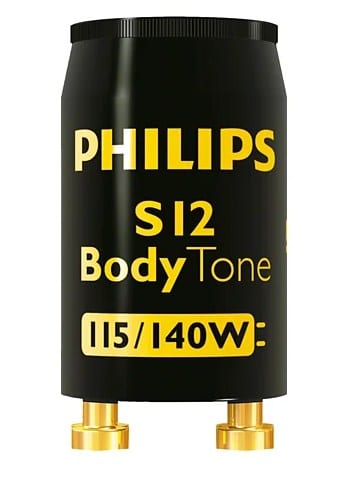 Philips S12 jump starter
Sylvania mark your product and see the symbol with the FS number. Kolkoto in a low number, sensible, in a golyama capacity, they can and bdat svyarzan lampite.
- FS-11 - 4 ... 62 W;
- FS-22 - 4 ... 22 W.
Important! If you wish, you can have intentions and other markings. For example COP or PBS.
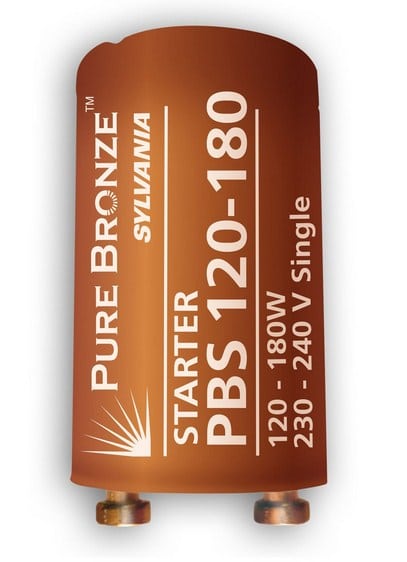 Sylvania starter with PBS marking back kjm sdzharzhanieto ↑
How to choose a starter - practically try on
Let's figure out how to choose the "correct" starter for your fluorescent lamp. The main criterion for the operation is the voltage on the lamp, with which the starting device is in contact, and the power is too low.
Voltage. Usually the manufacturers do not consider the working voltage on the samata lamp, such a shake and be smart. Look at the lamp, which is necessary, the premahwame has protective glass and calculates the working voltage on the source to light, which is flat on the bottom. It is for this voltage that we elect a starter.
Working voltage on the lamp, V Broy lampi, br. Broy droseli (ballast), br. Working voltage on the lamp, V 220112202202222022021110/127110/12711110/127110/12722110/127
Power Tova this refers to the power of the lampat. The same one is pointed at the kolbat LL before the letter W. On the snapshot along the bottom, left, the power is 30, and in the right - 18 W.
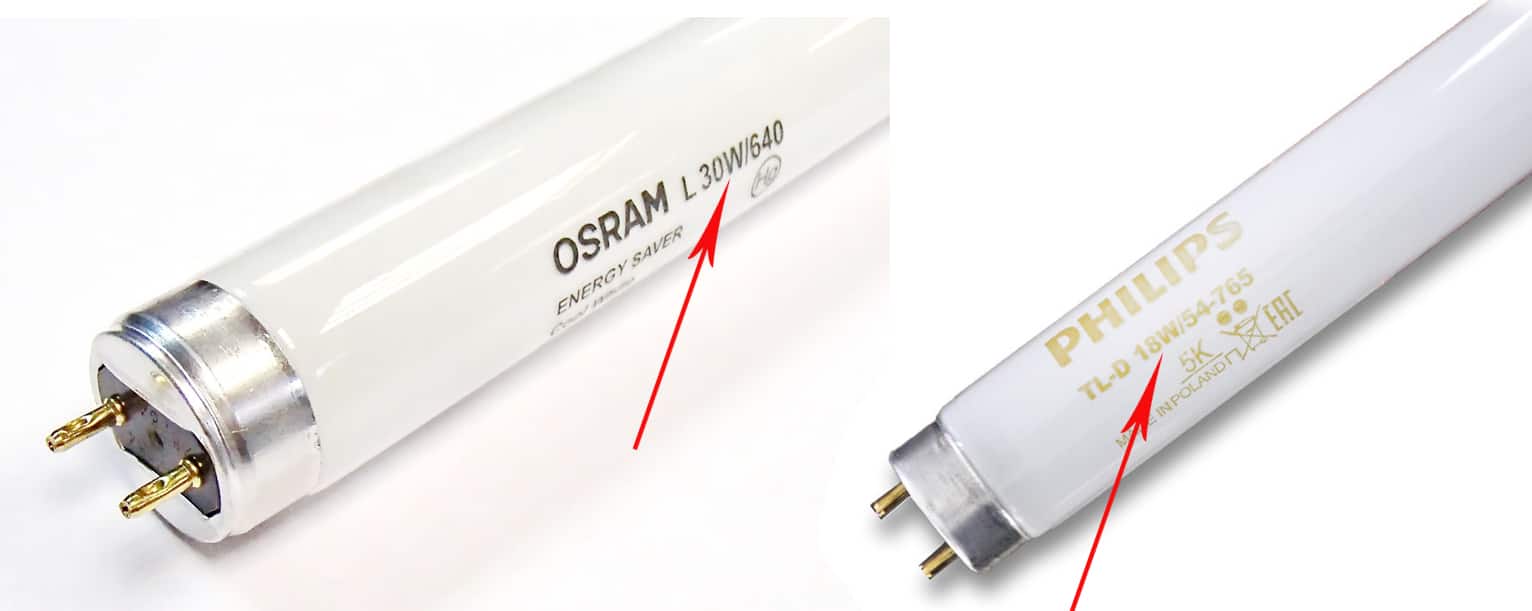 Designation for power on a fluorescent light source
Ako power on the lamp of falling into the range, it is sharp on the descent, then the camp is more. Dispute the main characteristics of the selected starter, repeat the stop:
- Stomach... Ordinary operation of the stomach on the gas discharge starter e 6000 switching on, electronic-3-4 five for a long time.
- Price... The electronic modification is not a little bit different from the modification with a gas discharge, in spite of which there is little predominance.
- Ime na markata… Commodity is the main indicator for quality. The starter device is of unknown manufacturer, it may damage the trace of the first turn on and light up and “kill” the lamp itself.Produced from fame manufacturers are not very smart, but the probability of being used from outside when they are used is significantly lower.
- Material for the body... Ima is huge broy kalfi, made from various materials. Those sa positionings from the seller are kato nai-irritable, eternal and incombustible. Do not tryabva and pay special attention to the parameters. First of all, all rocket launchers work in "cups" conditions, and secondly, the statement that the seller is honest is in itself for good sales.
For example, let's choose a starter for a fluorescent lamp. Imame lighting device is a single lamp, which is connected to a 220 V. On the kolbat, to one from the tsoklite, four neiniya capacitate. Let's talk 36 vata. Working voltage on LL, based on the tabelata in the mountain, e 220 V.
Almost all starters can and work within a certain range for voltage and power. We choose an option, in the framework for some parameters, our lamp will be dissuaded. Tosi from OSRAM is not good.
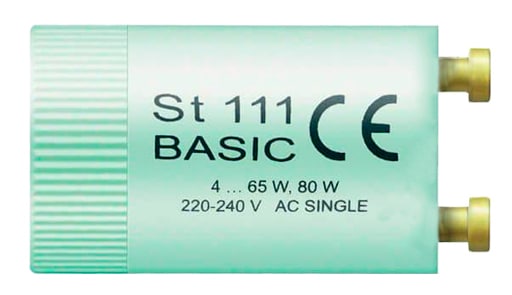 Starter for fluorescent lamp ST 111
You can choose the electronic version for the starter from a different company. Tova struva sit down five more.
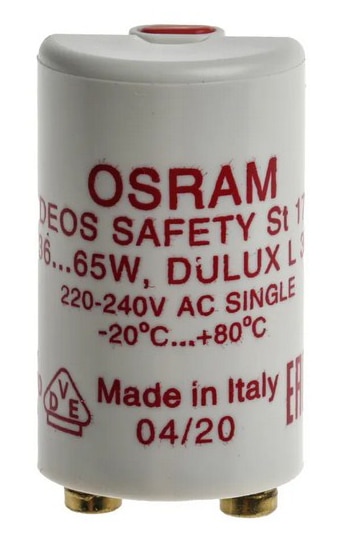 Electric starter ST 171
And one more example. Lamp for 220 V, two lamps. Let's take apart the electromagnetic ballast and install it in the lighting device. For yes, send a comrade, more tryabva yes go partially. Ako ima itself is a single ballast, lamp sa design for a voltage of 110 V. Power, somehow in the first case, reproach the top of the lamp. Yes, let's say 18 watts anyway. Let's leave and choose starters (Ima 2 from tyah spored broya on the lamp), chiito ranges for power and voltage will be dissuaded by parametrization on sewing from the light source. Tosi Philips e good.
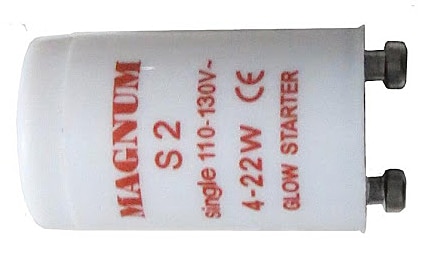 Tosi starter is rated for 110-130V and can work with a 4-22W plug.
There are a lot of markings on the rocket ima. It’s for good reason that you choose a starter not according to alphanumeric designations, in some forest and all objects, but according to real numbers per product weight.
Razbrahme for how sa starter on fluorescent lamps, how the sa tezi of the device and how they work. Now it is not difficult to check the correctness of the starting device and let it take it up again, but replace it unsuccessfully.
PredishnaLuminescent deviceThe device and the principle of acting on a ballast for a fluorescent lamp